Friday, October 15, 2010

Salamat (Thank you)


I wanted to share a letter one of the girls made for all the staff at My Refuge House right before she left. It is a thank you poster. In summary, it says "Thank you for teaching me how to read and write, and thank you for loving me even when I had a very bad attitude."

One life at a time.

Friday, September 24, 2010

A Bottle of Coke

Laws for squatters (persons who settle on land that is not legally theirs) can be ironclad here. Often the owner of the land will lose considerable amounts of money because the "squatters" refuse to leave without a settlement, and, by law, they don't have to. There are fires, almost weekly, in Cebu, usually in squatter areas, because owners get fed up with the people not leaving and just burn them to the ground.

It can be very frustrating on both ends. For the owner of the property, and the "squatters" on the property.  180,842 families, or 12.8 percent of the population in my region of the Philippines (The Visayas) are technically squatters (2004 report). And even though the laws are frustrating for my end of the population, that is a huge number of persons who would otherwise be homeless, and the injustice of that, is much more frustrating. 

 squatter home with the boats and pier in background
Last month I visited one of the most devastated districts in Cebu. It's an area, by one of the piers, whose tenants earn their living by scavenging in and around the pier area. They were squatters, but had built homes and lived by the pier for many years, some for many generations. Their homes had been demolished to build a shipping warehouse, and they became, by definition, displaced peoples. This community of around 15 families, couldn't leave the area, which supplied the only livelihood they knew, so they moved into a pile of old shipping/building materials. Literally. Tarps and sheet metal had been placed on top of cement drums to form make-shift structures that I had trouble believing would hold up during a storm.

The team I went with to this area was a Catholic Ministry called SVD who UNICEF has partnered with to do a joint project in providing aid to some of the neediest families. The workers go into these communities weekly and help the families get birth certificates for their children, make sure the children are in school, and try to provide assistance to help the kids stay in school. They also pass out condoms. Because, as you can imagine, sex brings in money. Sometimes more money than scavenging, but not always.
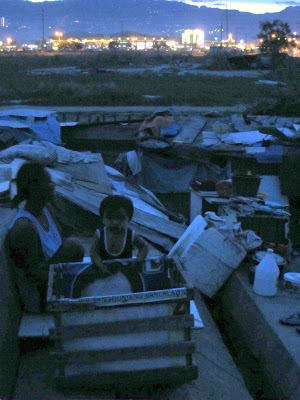
Lights from shopping district seen behind
Someone in this particular community informed the worker that her neighbors will sometimes sell their bodies for a liter of coke. One liter of coke. Many of the girls who are participating in these activities are very young, barely teenagers. The position of SVD in this area is that they will not convince someone to disengage from income generating activities unless they have another job to offer them. In the face of such devastation, they believe, asking them to stop these activities will only shame them when they have no other means. So they offer jobs, whenever they can. But that isn't often. There aren't a lot of jobs for those without resources.

As we walked back towards the city lights in the dusk, two persons heard us and stepped out from behind a structure, hoping we were customers. When they saw who it was they were embarrassed, but the SVD workers didn't even react. They treated them with the same love and dignity they would have treated their family members with.

The definition of trafficking is this: the recruitment, transportation, transfer, harbouring or receipt of persons, by means of the threat or use by force or other forms of coercion, of abduction, of fraud, of deception, of the abuse of power or of a position of vulnerability or of the giving and receiving of payments or benefits to achieve the consent of a person having control over another person, for the purpose of exploitation.


By this definition, anyone who buys these persons, with full knowledge that they have no other means for providing for themselves or their family, is trafficking them.


How does someone get to a place where they believe that their body is only worth a liter of coke? How does someone ever become that desperate? And how do you teach, love, care for, convince, empower or show someone that they are worth more?

They are worth much more.

Thursday, September 16, 2010

Breaking Ground

The construction has officially begun!

We broke ground on Monday, September 13th, 2010. The fencing contractor has been hired and the fence is currently going up! Here's a picture of Pastor Noel, the secretary of our local board and I doing the official ground breaking (It's a good thing I'm not actually part of the construction crew... It took me way to long to dig a scoop of dirt!)

Here's a picture of the whole crew in attendance. It includes our contractor, architect, government engineers, government officials, and IJM staff. 


Pastor Noel gave a short service and we Thanked God for the provision of this land and everything it will be used for. Then we had a gigantic meal complete with Lechon (a roasted pig). 

It was the perfect way to begin our mission!

Sunday, August 22, 2010

Hanging Rice

Last week I went to Lorega, a district of town known for it's pig slaughter house, drugs, and some of the most extreme poverty in the city. I went with a church ministry from the area that visits families there weekly. We walked down the road, and turned into a pathway that was only about a foot wide and whose walls were stained with every imaginable toxic substance. This path looked like it might lead to a sewer or an outhouse. Instead, it took us to a small community of homes that were situated in and around a cemetery.

One of the women we talked to said she had been living in this community since she was born, 35 years ago, and her mother had lived there before that. The homes were literally stacked on top of and all around above-ground grave sites. People were sitting on top of graves as if they were park benches, smoking cigarettes and laughing at each others jokes. Children playing with handmade toys in front of the deceased whose living relations had long since forgotten about them.

This may seem kind of weird for Americans, but the weirdest thing to me is this: Filipinos are terrified of cemeteries and typically avoid them at all cost. A local Pastor who was coming along on this trip for the first time was amazed, and said he'd never seen anything like it. But it's survival of the fittest in these parts, desperate times call for desperate measures, and (insert survival cliche here).

The same woman who has lived in this cemetery her entire life was working intently at weaving with her mother. They were weaving little pods that are used to cook rice in, and it makes individual servings. It is called "Puyo" or Hanging Rice, because when it is sold, the Rice is hung up for people to buy from the vender. The two women sit on the graves for around 5 hours a day, making these little pods. Together, they can construct about 300 of them in that amount of time. Later they will sell all 300 for 21 pesos. 21 pesos a day is the entire income for this family. $0.46 American cents.

As you can imagine, this area is also known for trafficking. Some families would rather try to sell their children than spend five hours weaving for a almost no profit. It doesn't make it right, obviously, but it's the reality.

(finished product: multiple cooked Puyo in a bowl, ready to break open and eat)

It's important for us to see where the clients are coming from. It's important to know what is driving them and their families towards decisions that seem unthinkable and outrageous. It's important to know what we are up against. We can't save all of Lorega. But we can make a difference for some. One life at a time.

Monday, August 2, 2010

Another goodbye

I've been saying good bye to friends a lot lately. Part of living in an international community means people come and go quite frequently. I'm not a huge fan of good byes. Most people aren't, I guess, but we make plans that may or may not ever happen to meet up again, somewhere in the world, and they seem a little more bearable.

Two weeks ago, I had to say a different kind of goodbye. A kind of goodbye that, no matter how good of a planner I am, I cannot hope to meet up again, in this world.

When I began working for IJM, Charito (or Ate Cha-- Older sister Cha) sat next to me in the social work section of the office. Ate Cha had an incredible ability to make people feel loved within seconds of meeting them. She was the first to reach out to me and take me under her wing. She translated for me when I could not understand the conversation, she filled me in on background information and inside jokes, she laughed and sang and joked and hugged and shared food with everyone around, most of the day. There wasn't anyone who didn't feel loved by this amazing woman.

Ate Cha had been battling cancer for 5 years. Her husband is a pastor in a village on another island, but she was so dedicated to the work of IJM that none of these things mattered. She poured her heart and soul into her interactions with clients, and many of them loved her like the mother they never had. When I would go on visits with her, I would watch their faces light up when she walked in the room; they also knew what it meant to experience the love of this amazing woman.

A few months ago, Ate Cha left IJM in order to take care of her health. But she didn't really stop working. She volunteered at different organizations and worked in her husbands church. Even though we knew she had cancer, no one really believed she was sick... she just never stopped giving.

However, the cancer that was in her lymph nodes spread to her bone marrow, and although she tried chemo again, her body just couldn't take anymore. She left the world peacefully, just closed her eyes and passed on. A fight well fought.

Please pray for Ate Cha's husband, 3 children, one grandson, and countless friends, as they transition into a life without their loved one.

And may we all fight a fight worth fighting for, and be able to rest peacefully for a job well done.

Thursday, July 15, 2010

Kristoff

Nicholas Kristoff wrote an article called "Seduction, Slavery and Sex" in the New York times.

He wrote about a scenario that we often see over here in the Philippines:

In a typical case, a rebellious 13-year-old girl runs away from a home where her mother’s boyfriend is hitting on her. She is angry and doesn’t trust the police. She goes to the bus station in hopes of getting out of town — and the only person on the lookout for girls like her is a pimp, who buys her a meal, offers her a place to stay and tells her he loves her.

The next thing she knows, she’s having sex with four men a night and all the money is going to her “boyfriend.” If she voices reservations, he puts a gun in her mouth and threatens to blow her head off.

Her customers, often recruited on the Internet, may have no inkling that her actions are not completely voluntary. Some mix of fear, love, hopelessness and shattered self-esteem keep her from trying to run away.


Check out the article if you get a chance!

Monday, June 21, 2010

Our New Refuge

At the end of May, a team of architects made their way to Cebu and spend a few days with me. We drove around the city, listening to Glee (My current favorite soundtrack to life) and looking at building designs. This team, who call themselves Visioneering Studios, decided to tackle our project as their one pro bono project of the year, and gave their time and energy to developing our new facilities for free. I have to say, at the end of those 2 1/2 days, when they showed me their sketches, I was amazed. I can't believe they were able to design this is such a short period of time! It's beautiful, and they really worked to meet all of our anticipated needs.

(Our new Facilities!!)

The drawing above is what the team went back to California and developed. Isn't it gorgeous?? We have to have a very high fence for security reasons, but they were able to incorporate the building into it and make the front softer and less intimidating. That front building will be admin and counseling rooms, meeting rooms, library and kitchen. Five of the structures in the bottom area will be homes. They can house 6 girls each, and will be set up to accommodate a family style situation (which is much more therapeutic than a group home!). The other structure, is actually an open area that we will use for any kind of meetings or gatherings or programs. The best part is, the property is on a hill, so if people are standing in that open area, they will be able to see the ocean, even with the high wall at the bottom!

(A view of our property, just purchased this week! See the Ocean?)

At the top part of the property, outside of the gate, we will build another home, that can be a transition home. We are finding, with our clients, often times they are older, or have children, and don't fit the requirements for other shelters who offer education or other services. We want to fill that gap. We will build this transition home so that those who are not appropriate for other placements, and can't go home, will still have a chance to go to school, or get a job and save money, before going out on their own.

So much of recovery depends on feeling safe. Safety is accomplished by physical surroundings, structure, and relationships that are built. I have watched girls lives change by the relationships they have built with our staff here. And I'm so thankful that Visioneering drew this concept of safety and relationships into every aspect of their sketch. It just looks... peaceful. Don't you think?

Right now, the MRH board is in the process of fund raising to build this new facility. If anyone wants to help by giving or hosting your own fundraiser, please let me know! We desperately need it to so we can make this sketch a reality!

Thursday, June 17, 2010

2010 TIP Report

2010 Trafficking in Persons Report is out. Check it out.

This is the 10th annual report. 177 countries were reported on and the US was one of those for the first time ever. The Philippines is still holding a "Tier 2 Watch List" status. Which means it is still one of the:

Countries whose governments do not fully comply with the TVPA’s minimum standards, but are making significant efforts to bring themselves into compliance with those standards, AND: a) the absolute number of victims of severe forms of trafficking is very significant or is significantly increasing; b) there is a failure to provide evidence of increasing efforts to combat severe forms of trafficking in persons from the previous year; or, c) the determination that a country is making significant efforts to bring themselves into compliance with minimum standards was based on commitments by the country to take additional future steps over the next year

For the full list of countries and placements for this years report click here

Saturday, June 12, 2010

Death of a Child


Today I attended the funeral of Jomar Sagarino.

Jomar was found when he was 11 years old, but those who lived with him at Happy Horizons said he looked like he was six months old. Jomar was severely disabled, both physically and mentally, and had been rejected and hidden by his family members all of his life. I've been told he was found in something similar to a cage, swimming in h
is own feces. The doctor gave him two weeks to live. A few months later, the doctor said he would not make it past his twelfth birthday. That was 10 years ago.

When I worked at Happy Horizons (2002-2004), every kid had chores they had to do daily, and they would do them in rotations. The boys usually took turns caring for Jomar. Although he had grown in stature (he was probably around 4 feet tall), he needed help with everything: feeding, bathing, exercising his legs, changing his diapers, he was still that baby that had been found neglected.

It was amazing to watch the boys who cared for him. Often, at first, they would be annoyed if it was their turn to take care of Jomar. I could see it in thei
r faces. They would have to sit close to him, while he sat in his wheelchair and they had less free time. But eventually, their hearts would soften, their expressions would change.

Because Jomar was like a baby in other ways. He was sweet tempered, joyful to be around, and enjoyed life. He rarely cried, and he would laugh when you played with him. Sometimes, I would catch one of the boys, who wasn't on "duty," playing with Jomar, and Jomar would recognize his voice. Jomar, as only a baby can, brought joy to lives around him, and taught many children how to love well.

Jomar will be terribly missed, as evidenced by the number of people who were present at his funeral. But, as he finally uses his legs for the first time, by himself, and finds his voice, uninhibited, before God, I cannot wish him to be back here. I can only thank God for giving us a precious gift, a 10 year gift, that taught so many, so much.


Below: Some of the young men who have helped care for Jumar.

Saturday, May 22, 2010

Two Week Check In


Well, I've been back to Cebu for 2 whole weeks, and it feels like a lifetime. I've never been so busy in all of my life... and I've had some pretty busy chapters in life.

Most of what I'm doing is pretty boring to write about on a blog. But there are a few things that might be interesting to the general public, so I'll try to recap them in a way that won't cause you to fall asleep.

First, "My Refuge House" is in the process of buying our own property! We have been renting a facility since conception, but we were given a very generous donation to buy land and have begun the process! Buying anything in the Phils has it's challenges, for those of us who are used to American consumerism, however, buying a piece of property here, is, well, unlike anything I've ever done before, and stock full of TIA moments.

For instance, when we interviewed people about the property, they said there was water there, no problem for that. What they meant was "The property next door has a well we can use anytime we want." So, we will have to dig out own well. But at least it will be good water! (At least, that's what we've been told...)

Also, there are permits for everything. And ridiculously high taxes. And notaries. And fees. And documents. And more documents. And stamps. And approvals. It's no wonder there are so many squatters in the the Philippines... buying property is expensive and hard!

On the up side... the property is beautiful! It's just over 6000 sq meters on a hill with a view of the ocean. And the price they gave us was really good because the title had been mortgaged. I'm really excited to move to the facility there.

... After we build it. Although we have the money to buy the property, we don't have all the necessary funds to built the house(s) yet. The board in the US is working hard on a campaign to get the money raised, but we could use your prayers!